Which Current Power 4 College Football Programs Have Improved or Declined the Most by Decade?
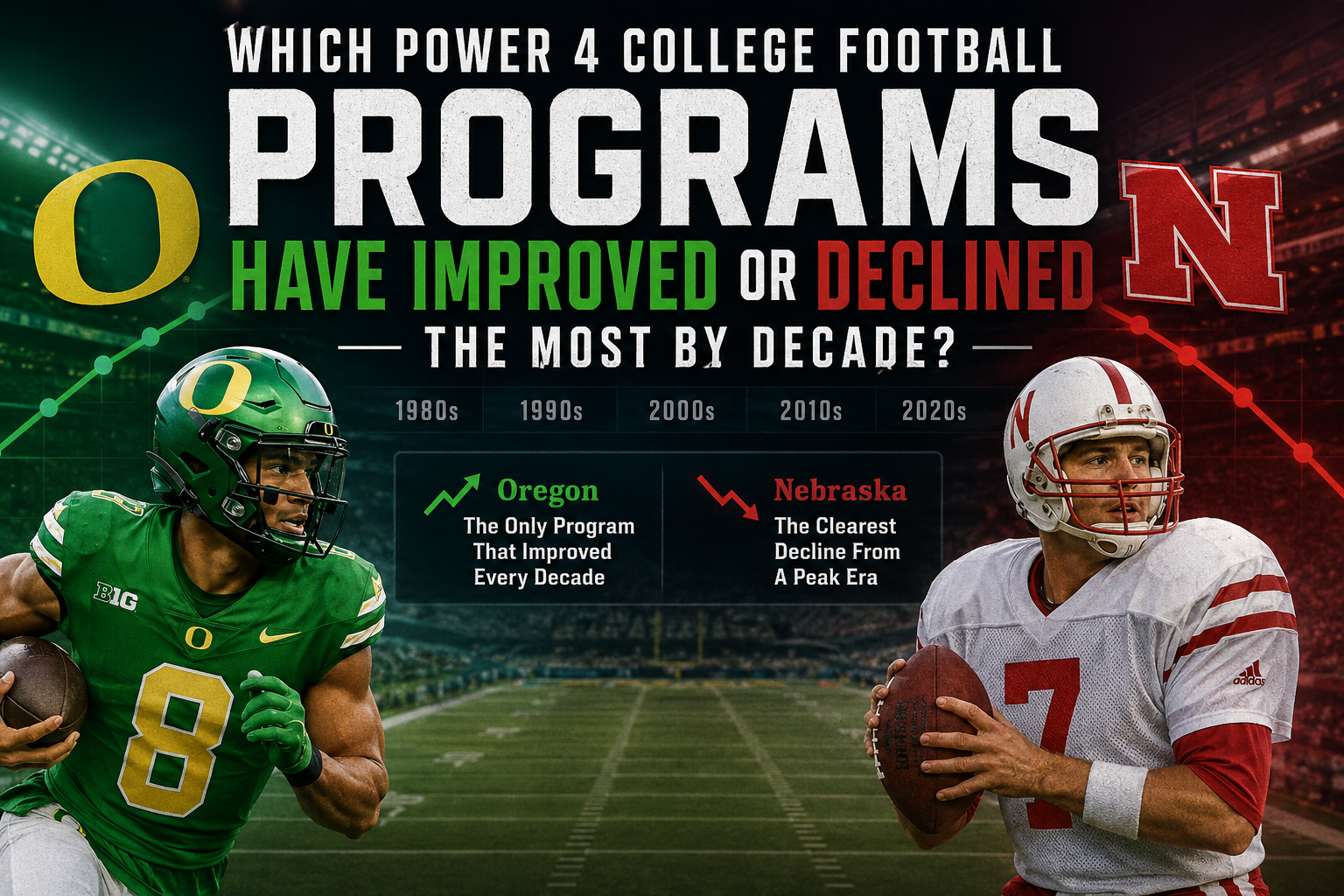
A decade-by-decade look at current Power 4 teams shows Oregon as the only program that has improved every decade since the 1980s, while Nebraska and Florida offer two of the clearest decline-from-peak stories.
On this page
College football history is usually told through national championships, legendary coaches, rivalries, and a handful of unforgettable teams. But when you zoom out by decade, a different kind of program story appears.
Some schools did not simply have one great season or one strong coaching run. They raised their long-term baseline from one era to the next. Others once looked like permanent national powers, only to drift back toward the middle over time.
Using CFBTrack's team-season data, I compared current Power 4 programs across five windows: the 1980s, 1990s, 2000s, 2010s, and the 2020s so far. For this article, "Power 4" means teams currently listed in the ACC, Big Ten, Big 12, or SEC.
The 2020s window covers 2020 through 2025, so it is shorter than the earlier full decades. Win percentage counts ties as half-wins. This is also a straight win-percentage comparison, not a schedule-adjusted rating, so conference strength, schedule difficulty, bowl volume, and era changes are not baked into the numbers.
The cleanest result is also the most striking: Oregon is the only current Power 4 program whose win percentage improved in every single decade.
| Team | 1980s WP | 1990s WP | 2000s WP | 2010s WP | 2020s WP |
|---|---|---|---|---|---|
| Oregon | .464 | .593 | .696 | .759 | .805 |
Oregon was below .500 in the 1980s. The Ducks became a solid winning program in the 1990s, moved into top-tier territory in the 2000s, became a national contender in the 2010s, and have been even better by win percentage in the 2020s.
The scoring numbers tell the same story. Oregon went from a negative average scoring margin in the 1980s to a dominant modern profile.
| Oregon Metric | 1980s | 2020s | Change |
|---|---|---|---|
| Win percentage | .464 | .805 | +34.1 percentage points |
| Avg. scoring margin | -1.5 | +14.6 | +16.1 points/game |
That makes Oregon the best pure "program build" example among current Power 4 teams. This was not just one hot coach, one elite roster cycle, or one memorable run. The decade-by-decade trend shows a program that kept raising its floor.
The numbers do not explain every reason Oregon made that climb, but the trend lines up with the larger story around the program: major investment, stronger national branding, improved facilities and recruiting, and the Chip Kelly era turning Oregon into one of the sport's most recognizable modern programs. The data shows the climb. The context helps explain why it stuck.
The Biggest Long-Term Climbers#
Oregon is the only perfect decade-by-decade climber, but it is not the only program that looks dramatically different now than it did in the 1980s.
If we compare 1980s win percentage directly to 2020s win percentage, Kansas State owns the largest gain among current Power 4 programs with a broader 1980s sample.
| Team | 1980s WP | 2020s WP | Change | Scoring Margin Change |
|---|---|---|---|---|
| Kansas State | .203 | .613 | +41.1 percentage points | -14.9 to +6.9 |
| Oregon | .464 | .805 | +34.1 percentage points | -1.5 to +14.6 |
| TCU | .324 | .627 | +30.2 percentage points | -7.0 to +4.9 |
| Ole Miss | .451 | .740 | +28.9 percentage points | -3.1 to +12.3 |
| Cincinnati | .355 | .622 | +26.7 percentage points | -9.2 to +8.1 |
| Northwestern | .173 | .423 | +25.0 percentage points | -19.5 to -4.3 |
Kansas State is the extreme turnaround case. The Wildcats were 21-87-3 in the 1980s, a .203 win percentage with an average scoring margin near minus-15 points per game. In the 2020s, they are 46-29 with a .613 win percentage.
That is more than a better record. It is a different program identity.
Kansas State went from one of the weakest major-conference programs in the country to a stable, competitive Big 12 program. Oregon may be the cleanest decade-by-decade riser, but Kansas State is the best pure turnaround story.
A Note on UCF#
UCF technically belongs near the top of the long-term improvement list, moving from a .167 win percentage in its 1980s sample to .527 in the 2020s. But that 1980s sample includes only four seasons, which makes it harder to compare directly with programs that played the full decade at the FBS level.
That does not make UCF's rise any less interesting. It just makes it a different kind of story.
UCF's arc is less about decade-by-decade Power 4 comparison and more about program elevation: from outside the sport's power structure to a current Big 12 member with a winning 2020s profile. That belongs in the broader realignment conversation, but it should be treated separately from full-decade turnaround cases like Kansas State, Oregon, TCU, and Cincinnati.
TCU and Cincinnati also fit that modern realignment theme. Both programs spent much of this historical window outside the power-conference structure, but their long-term records help explain why they eventually became part of the current Power 4 map.
Northwestern is another kind of climber. The Wildcats are not a modern powerhouse, and their 2020s record has slipped. But their 1980s baseline was so low that becoming competitive at all represents major long-term improvement. Northwestern went from .173 in the 1980s to .500 in the 2000s and .563 in the 2010s before sliding back in the 2020s.
Why Declines Do Not Mirror Rises Perfectly#
The decline side is more complicated.
Program growth can sometimes show up as a clean staircase. A school improves its recruiting, investment, conference position, facilities, coaching stability, or national brand, and the results can build over multiple eras.
Decline is usually messier. Even programs that fall from a peak often have rebound seasons, strong coaching hires, or short bursts of success along the way. That is why there is no exact opposite of Oregon in this dataset.
No current Power 4 program got worse in every single step from the 1980s to the 1990s to the 2000s to the 2010s to the 2020s.
But several programs have obvious fall-from-peak profiles.
The cleanest examples are Nebraska and Florida. Both peaked in the 1990s, then declined in every decade after that.
| Team | 1980s WP | 1990s WP | 2000s WP | 2010s WP | 2020s WP |
|---|---|---|---|---|---|
| Nebraska | .837 | .868 | .656 | .581 | .414 |
| Florida | .662 | .820 | .769 | .638 | .493 |
Nebraska's line is the most dramatic in the dataset. The Huskers went 103-20 in the 1980s and 108-16-1 in the 1990s. Since then, their win percentage has fallen from .868 to .656 to .581 to .414.
Their scoring margin tells the same story. Nebraska averaged +24.8 points per game in the 1980s and +23.6 in the 1990s. In the 2020s, that number is just +0.8.
Florida's decline is not quite as steep, but the pattern is clean. The Gators were an .820 program in the 1990s, remained excellent in the 2000s at .769, fell to .638 in the 2010s, and are under .500 so far in the 2020s.
Biggest 1980s-to-2020s Fallers#
If we compare the 1980s directly to the 2020s, Nebraska stands alone. But several other major brands also show significant long-term decline.
| Team | 1980s WP | 2020s WP | Change | Scoring Margin Change |
|---|---|---|---|---|
| Nebraska | .837 | .414 | -42.3 percentage points | +24.8 to +0.8 |
| Auburn | .731 | .452 | -27.9 percentage points | +11.1 to +3.1 |
| Arkansas | .717 | .438 | -27.8 percentage points | +9.6 to +1.2 |
| Florida State | .744 | .528 | -21.6 percentage points | +14.7 to +4.4 |
| UCLA | .720 | .522 | -19.9 percentage points | +10.4 to +1.8 |
| Miami | .832 | .649 | -18.3 percentage points | +16.3 to +9.4 |
| Virginia Tech | .584 | .411 | -17.3 percentage points | +5.1 to -0.8 |
Auburn and Arkansas are notable SEC examples because their 1980s baselines were strong and their 2020s records are below .500.
Florida State and Miami add ACC weight. Both programs have still had periods of modern success, but compared with their peak decades, the numbers show a clear step back.
Miami is especially useful because it shows why decade framing matters. The Hurricanes were elite in the 1980s, remained elite in the 1990s, and were still very good in the 2000s. Then came a sharper drop in the 2010s. Miami's 2020s win percentage has rebounded to .649, but that is still well below its 1980s peak.
Virginia Tech is another interesting case because its decline is not from the same national-title peak as Nebraska, Miami, or Florida State. Instead, the Hokies show what happens when a long period of program stability fades. Their 2020s profile is much closer to the middle than to the Frank Beamer-era standard that defined the program for so long.
What This Says About Program Power#
A decade-by-decade comparison helps separate one-year noise from structural program change. It shows which schools changed their long-term baseline, not just which teams had one great season.
Oregon is the headline because it is the only perfect riser. Kansas State is the best pure turnaround. Nebraska is the clearest long-term decline from a national-power peak. Florida is one of the cleanest post-1990 decline-from-peak cases. Miami and Florida State show how difficult it is to sustain a dynasty-level identity across multiple coaching eras.
The most interesting part may be what comes next.
Nebraska is trying to prove its 2020s number is a low point, not a new normal. Florida is trying to climb back toward the standard it set in the 1990s and 2000s. Miami has already improved from its 2010s dip, but the question is whether that rebound can become something closer to its old national profile. Oregon, meanwhile, enters the next stretch trying to turn the best long-term climb in the Power 4 into the one thing still missing from the resume: a national championship.
That is what makes decade framing useful. It does not replace all-time history. It adds a sharper question.
Which programs are still building toward their next peak, and which ones are still trying to escape the shadow of their last one?
For more context, compare these teams on CFBTrack's all-time wins leaderboard, program rankings, and individual team pages for Oregon, Nebraska, Florida, Kansas State, Miami, and Florida State.