The Week 1 Ranked Kickoff Game Didn't Die. It Went Back Home.
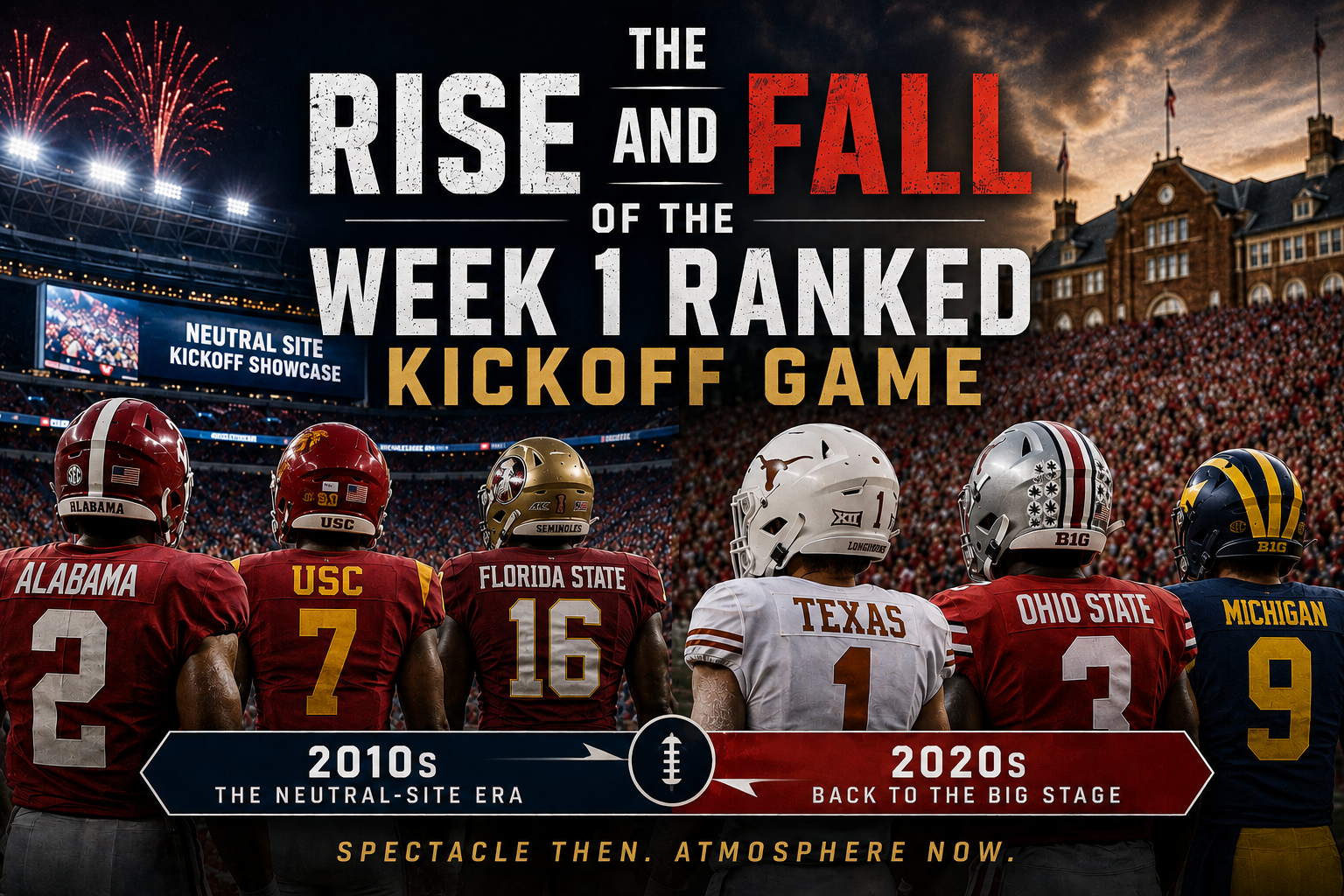
Week 1 ranked out-of-conference games exploded in the 2010s behind neutral-site kickoff showcases. The matchups have not disappeared, but the sport's biggest openers are shifting back toward hostile stadiums, true road trips, and campus-style atmospheres.
On this page
Week 1 in college football was not always built like a national event window. For decades, the sport had big openers, but they were usually scattered across the college football schedule: a risky road trip here, a blue-blood test there, and the occasional game that reshaped the national title race before most teams had even played.
That changed in the 2000s and peaked in the 2010s. Opening weekend became a made-for-TV proving ground, especially when neutral-site kickoff games turned Week 1 into something closer to a bowl preview. Atlanta, Arlington, Houston, Orlando, Charlotte, and other NFL-style venues gave the sport a polished opening act: big brands, clean TV windows, conference bragging rights, and months of offseason buildup.
The data backs up the memory. Using preseason AP Top 25 rankings, regular-season Week 1 only, FBS-vs-FBS only, and out-of-conference games only, the 2010s were the peak for volume. From 2010 through 2019, there were 163 Week 1 out-of-conference games involving at least one ranked team, an average of 16.3 per season. The decade also produced 22 ranked-vs-ranked games, six top-10-vs-top-10 games, and 17 neutral-site ranked-vs-ranked games.
That last number is the key to the whole story.
The big Week 1 game has not disappeared. The neutral-site kickoff showcase has.
The Fall Is Really a Format Change#
The simplest version of this argument would be to say teams stopped scheduling heavyweight openers. That is not really true.
From 2021 through 2025, there were still 13 ranked-vs-ranked Week 1 out-of-conference games. On a per-year basis, that is actually a higher rate than the 2010s. The 2025 slate alone produced three huge matchups: No. 1 Texas at No. 3 Ohio State, No. 9 LSU at No. 4 Clemson, and No. 6 Notre Dame at No. 10 Miami.
That was not a soft opening weekend. It was one of the sport's best recent Week 1 slates.
But the shape was different. None of those three 2025 games was played at a neutral site. Ohio State hosted Texas. Clemson hosted LSU. Miami hosted Notre Dame in its regular home setting at Hard Rock Stadium. The sport did not stop giving fans elite openers; it started sending more of them back into true home-site environments.
That distinction matters because it changes the feel of the game. The 2010s kickoff model gave fans spectacle. The newer model gives fans pressure: road uniforms, hostile noise, uneasy fan bases, and a setting that feels more native to college football than a half-filled NFL stadium split between two fan bases.
Before Week 1 Became a Product#
The early decades had important Week 1 games, but not a machine built around them.
In the 1980s, there were 21 Week 1 out-of-conference games involving at least one ranked team and eight ranked-vs-ranked games. In 1984, No. 1 Auburn opened at No. 10 Miami and lost 20-18, a result that immediately altered the national title conversation. In 1987, No. 16 Iowa went to No. 17 Tennessee and lost 23-22. In 1989, No. 22 Illinois beat No. 5 USC 14-13.
The 1990s raised the floor a bit, producing 25 Week 1 out-of-conference games involving at least one ranked team and 14 ranked-vs-ranked games. The best symbol might be 1990, when No. 5 Colorado opened at No. 8 Tennessee and the game ended in a 31-31 tie. Two top-10 teams, one national-stage opener, and no clean answer afterward: early-season uncertainty in its purest form.
Those games had stakes. They had consequences. But they were not part of a coordinated kickoff-weekend product. They were hard games on hard schedules, not television inventory arranged to make Week 1 feel like a mini bowl season.
The 2000s Built the Bridge#
The 2000s were the transition decade.
The ranked-vs-ranked count was modest: 10 for the decade. But the broader ranked-team volume jumped to 85, or 8.5 per season. That was the first sign that opening weekend was being repackaged.
By the end of the decade, the modern template was visible.
In 2008, No. 24 Alabama beat No. 9 Clemson 34-10 in a neutral-site game that now looks like an early national warning shot from the Nick Saban era. That same weekend, No. 20 Illinois and No. 6 Missouri played a 52-42 neutral-site shootout.
Then 2009 showed what the next decade would become. No. 16 Oregon went to No. 14 Boise State and lost 19-8. No. 13 Georgia went to No. 9 Oklahoma State and lost 24-10. No. 20 BYU beat No. 3 Oklahoma 14-13 at a neutral site. No. 5 Alabama beat No. 7 Virginia Tech 34-24 in another neutral-site showcase.
One opening weekend produced four ranked-vs-ranked out-of-conference games. The blueprint was set: national brands, national stakes, and a Week 1 schedule strong enough to carry the sport for an entire weekend.
When Week 1 Became a Showcase#
The 2010s turned that blueprint into habit.
Boise State's 33-30 win over No. 10 Virginia Tech in 2010 remains one of the great modern Week 1 games because it had everything the format wanted: a top-five outsider, a major-conference opponent, a neutral-stage spotlight, and a result that mattered nationally.
More followed. In 2011, No. 3 Oregon met No. 4 LSU. In 2012, No. 8 Michigan opened against No. 2 Alabama. In 2013, No. 5 Georgia lost 38-35 at No. 8 Clemson, one of the best home-site examples in the sample.
The format may have peaked in 2016. That opening weekend had four ranked-vs-ranked out-of-conference games, all at neutral sites: Oklahoma-Houston, Georgia-North Carolina, USC-Alabama, and Ole Miss-Florida State.
That weekend had the whole package: depth, brand power, conference contrast, and TV-friendly settings. It also showed why the SEC and ACC became so central to the trend.
Since 1980, the SEC has 39 team appearances in ranked-vs-ranked Week 1 out-of-conference games. The ACC has 22. The Big Ten has 21. The Pac-12/Pac lineage has 14, independents have 9, and the Big 12 has 8. The most common pairing is ACC vs. SEC, with 15 ranked-vs-ranked Week 1 games since 1980.
That is not just trivia. It explains the geography and economics of the kickoff era.
The SEC had the perfect ingredients: national brands, massive fan bases, television pull, and a footprint close to many of the neutral-site venues that defined the era. The ACC was a natural partner because Clemson, Florida State, Miami, Virginia Tech, North Carolina, and others could supply regional contrast without forcing the game too far outside the Southeast. The Big Ten had plenty of brand power, but its biggest programs were not always as tied to the Atlanta-Charlotte-Orlando style kickoff circuit.
The Big 12 number is especially interesting. Part of the gap is structural: the conference did not exist until 1996, so a "since 1980" count naturally gives it a shorter runway. But it also reflects how the league's biggest brands fit differently into the sport's scheduling economy. Oklahoma and Texas had major annual inventory already tied up in conference or rivalry structures, and many Big 12 showcase games tended to land in other weeks, in home-and-home series, or outside the specific Week 1 neutral-site lane.
In other words, the kickoff showcase era was not evenly distributed across the sport. It was powered most heavily by the SEC, fed by nearby ACC brands, and amplified by a handful of national programs willing to use Week 1 as a stage.
The team list tells the same story. Georgia has appeared 10 times in ranked-vs-ranked Week 1 out-of-conference games since 1980. LSU and Alabama have eight each. Clemson has seven. Miami and USC have six. Ohio State, Florida State, Boise State, and Penn State have five.
Some of those programs were chasing national respect. Some were chasing recruiting exposure. Some were taking attractive neutral-site payouts. Some, like Notre Dame and USC, have always lived a little outside the clean conference-schedule model. Together, they made Week 1 feel bigger than it used to.
Why the Neutral-Site Model Cooled#
The decline of neutral-site ranked openers is probably not about teams suddenly getting scared. It is more about incentives changing.
Neutral-site games made sense when they offered big payouts, national television exposure, recruiting visibility, and a way to play a major opponent without giving up a true road game. For a while, that was a powerful combination.
But the tradeoff has become harder to justify.
A home-and-home series gives a program something a neutral-site game cannot: a premium home ticket, a campus recruiting weekend, donor value, student energy, local economic impact, and a return game that fans actually want to attend. As athletic departments manage larger budgets, NIL-era spending pressures, and more expensive football operations, keeping a major game connected to campus can be more valuable than outsourcing the atmosphere to an NFL venue.
Realignment also changed the equation. With larger conferences and heavier league schedules, many power programs no longer need a neutral-site opener to find national-stage games. The SEC and Big Ten, in particular, can now generate more heavyweight inventory from within their own conference schedules. That makes the neutral-site kickoff less essential than it was when leagues needed more cross-conference events to create early-season buzz.
Fan taste matters too. Neutral-site games can look huge on television, but they often lack the thing college football does best. A split crowd in a pro stadium may feel clean and corporate. A true road opener feels dangerous. For fans, that danger is part of the appeal.
The Post-2020 Version Is Different, Not Weaker#
The post-2020 picture is not empty. It just looks less like the 2010s.
In 2021, No. 5 Georgia beat No. 3 Clemson 10-3 in a defensive game that helped shape the early read on Georgia's national championship team. In 2022, No. 5 Notre Dame opened at No. 2 Ohio State and lost 21-10. In 2023, No. 8 Florida State beat No. 5 LSU 45-24. In 2024, No. 7 Notre Dame beat No. 20 Texas A&M 23-13 on the road, while No. 23 USC beat No. 13 LSU 27-20 at a neutral site.
Then came 2025, which almost argues against the idea of a decline if the only measurement is ranked-vs-ranked volume.
Texas at Ohio State was No. 1 vs. No. 3. LSU at Clemson was No. 9 vs. No. 4. Notre Dame at Miami was No. 6 vs. No. 10 and finished 27-24.
The difference was not quality. It was setting.
Those games were not built around neutral-site branding. They were built around home-field pressure. That is a better version of Week 1 for a lot of fans, even if it is less tidy for television packaging.
The Better Trade#
The cleanest conclusion is this: Week 1 ranked out-of-conference games rose from scattered early-season tests in the 1980s and 1990s, became a broader scheduling trend in the 2000s, and peaked as an event product in the 2010s.
Recently, the sport has kept many of the elite openers. What has cooled is the neutral-site kickoff showcase.
That might be a good trade.
The 2010s gave college football spectacle: big logos, big TV windows, bowl-like venues, and offseason anticipation. The newer model gives the sport something closer to its roots: scarier road trips, louder buildings, and games that feel like they belong to the people in the stands as much as the networks broadcasting them.
A neutral-site Alabama-USC game looked big on paper.
Texas at Ohio State feels bigger in the bones of the sport.
Related CFBTrack Links#
- Check the latest Week 1 matchups on the college football schedule.
- Track movement in the AP Top 25 rankings.
- Explore each program's history on the team pages.
- Compare results and box scores in game stats.
Source Note#
Game counts use preseason AP Top 25 rankings, regular-season Week 1 only, FBS-vs-FBS only, and out-of-conference games only. Pre-2005 games are linked to team pages instead of game-detail pages because CFBTrack game detail pages start with the 2005 season.