Do Elite Running Backs Still Matter in College Football?
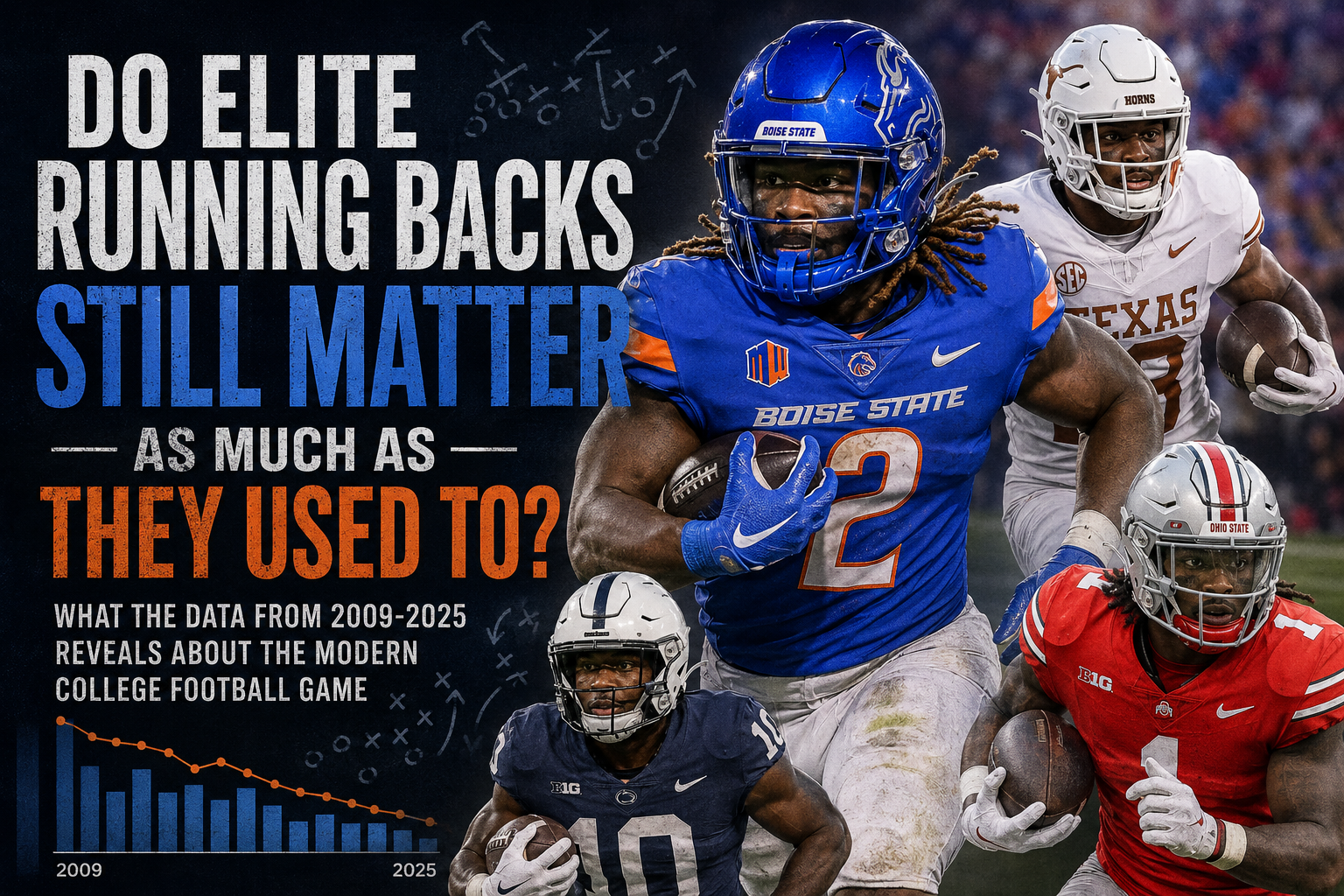
CFBTrack rushing data from 2009 through 2025 shows that elite running backs still matter, but the workhorse back is no longer the only blueprint for building an elite rushing offense.
On this page
In 2024, Ashton Jeanty became the kind of player college football used to revolve around.
Boise State handed him the offense, defenses knew the ball was coming, and it still barely mattered. He piled up rushing yards, controlled games, and carried a playoff-caliber team with a style that felt almost old-fashioned in modern college football.
A decade ago, that formula was common among elite teams. Great programs usually had a star running back at the center of the offense: Derrick Henry at Alabama, Jonathan Taylor at Wisconsin, Dalvin Cook at Florida State, Bijan Robinson at Texas.
But the modern sport looks different now. Many of the best teams in the country still run the football extremely well, yet fewer of them rely on one dominant workhorse back to define the offense.
That raises an interesting question:
Does an elite running back still matter as much as he used to?
Using CFBTrack regular-season rushing data and AP Top 25 rankings from 2009 through 2025, the answer is more nuanced than the popular "running backs don't matter anymore" argument.
The run game still strongly correlates with winning.
The workhorse running back is what has changed.
Methodology note: This analysis uses regular-season team and player rushing statistics from the CFBTrack database alongside AP Top 25 snapshots from each season between 2009 and 2025. Team overlap percentages compare ranked teams against national top-25 rushing leaders in both individual and team categories.
The Relationship Between Elite RBs and Elite Teams Has Softened#
The first thing the data shows is that elite college football teams still frequently have highly productive running backs.
From 2009-2013, the average AP Top 25 included 8.4 teams with a running back ranked in the national top 25 for rushing yards.
From 2021-2025, that number was still 8.2.
That is barely a change.
Rushing touchdowns tell a similar story. AP Top 25 teams averaged 9.6 top-25 rushing-touchdown backs from 2009-2013 compared to 9.0 from 2021-2025.
So the idea that "running backs no longer matter" does not really survive contact with the data. Roughly one-third of ranked teams still feature nationally productive RBs.
But the picture changes slightly when you zoom in on the very top of college football.
Among AP Top 10 teams, the overlap with elite rushing-yard running backs declined from 4.2 teams per season from 2009-2013 to 3.6 from 2021-2025.
For rushing touchdowns, the number slipped from 5.2 to 4.8.
That is not a collapse. It is a trend.
The best teams are becoming less dependent on one superstar back carrying the offense.
Strong Run Games Still Win#
One of the most important findings in the data is that strong run games still strongly correlate with winning.
From 2009-2013, AP Top 25 teams averaged 10.0 teams that also finished top 25 nationally in team rushing.
From 2021-2025, that number only declined to 9.0.
Even in an era dominated by spread systems, tempo, and explosive passing attacks, the run game remains one of the clearest traits of successful college football teams.
Physicality still matters. Controlling games still matters. Short-yardage efficiency still matters.
Especially late in the season.
What has changed is what modern rushing offenses actually look like.
Today's best ground attacks are usually built less around one volume runner and more around offensive structure: multiple backs, quarterback rushing threats, RPO systems, spacing stress, and offensive line depth all combine to spread production across the offense.
For readers who want to dig into the individual season side of the argument, CFBTrack's player season leaderboards and stat search tool make it easy to compare high-yardage rushing seasons across eras.
The Real Decline Is the Workhorse Model#
The team-level data still holds up. The individual distribution data is where the real shift appears.
What changes most noticeably across the dataset is how elite rushing production gets distributed. More top rushing teams are spreading carries across multiple players instead of leaning heavily on one feature back.
From 2009-2013, 36.4% of top-25 rushing offenses had one lead running back responsible for at least 60% of the RB-room rushing production.
From 2021-2025, that dropped to 30.4%.
At the same time, the percentage of elite rushing teams where the leading back accounted for less than half of RB-room rushing yards increased from 41.5% to 46.4%.
That trend shows up in the broader averages too. Among top-25 rushing offenses, the leading running back accounted for 56.3% of RB-room rushing yards from 2009-2013. From 2021-2025, that slipped to 52.7%.
The raw percentage change is modest on its own. But paired with the threshold trends, it points consistently in the same direction: top rushing teams are relying less on one feature back and more on shared production.
Even the traditional "RB1 and RB2" structure has loosened slightly. The top two backs combined accounted for 80.7% of RB-room rushing yards from 2009-2013 compared to 77.8% from 2021-2025.
Modern backfields increasingly rotate situational roles instead of funneling every carry to one star.
Recent AP Top 10 Teams Show the Shift Clearly#
The 2024 season makes the trend easy to visualize.
Georgia, Texas, Penn State, Ohio State, and Indiana all reached the AP Top 10 without featuring a top-25 running back in rushing yards.
Those teams still ran the football effectively. They just did not rely on one nationally dominant statistical star.
Georgia's leading back in the database snapshot, Nate Frazier, had 634 rushing yards. Texas' Tre Wisner had 863. Penn State's Nicholas Singleton had 838. Ohio State's Quinshon Judkins had 805. Indiana's Justice Ellison had 811.
Those are productive, valuable running backs. But their teams were not built around feeding one player 25 carries a game.
Early 2025 data suggests the trend continued.
Indiana reached No. 1 in the AP snapshot while Roman Hemby led the backfield with 918 rushing yards, only 40th nationally among RBs. Oregon climbed to No. 5 while Noah Whittington led its backs with 774 yards and only 33.5% of Oregon's RB-room rushing production.
That does not prove the model has permanently changed. Single seasons can be noisy. But it does reinforce the broader multi-year pattern showing that top ground attacks increasingly rely on depth, balance, and efficiency rather than one player dominating the national rushing leaderboard.
The Counterexamples Still Matter#
None of this means elite running backs are obsolete.
Far from it.
Boise State's 2024 offense with Ashton Jeanty showed exactly how devastating a true workhorse RB can still be. Arizona State with Cameron Skattebo and Tennessee with Dylan Sampson also proved that one elite back can still define an offense and elevate a team.
The difference is that modern contenders no longer require that kind of player.
An elite running back still changes defensive spacing. He still creates explosive plays from imperfect blocking. He still helps quarterbacks survive difficult situations and closes games in bad weather or hostile environments.
But increasingly, elite college football teams can generate those advantages collectively instead of through one player dominating the stat sheet.
So, Does an Elite Running Back Still Matter?#
Yes.
Elite running backs still change games. They force defenses into uncomfortable fronts, stabilize offenses in difficult situations, and help teams control games when conditions become physical late in the season.
What has changed is how necessary that archetype is for elite team success.
The best teams in modern college football still run the ball effectively, but they increasingly do it through complete offensive ecosystems rather than one dominant workhorse back. Committee backfields, quarterback involvement, tempo, spacing, and offensive design now absorb some of the value that once belonged almost entirely to a single star runner.
The elite running back still matters.
He is just no longer the only blueprint for building an elite rushing offense.
Related CFBTrack Pages#
- AP Top 25 rankings archive
- College football player season leaders
- Rushing yards leaderboard
- Rushing touchdowns leaderboard
- Player stat search for 1,800-yard rushing seasons
- Boise State team page
- Oregon team page
- Indiana team page
- Georgia team page
- Texas team page
- Penn State team page
- Ohio State team page