So You're a Fútbol Fan and Want to Learn About College Football
A World Cup-ready guide for fútbol fans trying to understand college football: downs, tailgates, 100,000-seat stadiums, rivalries, marching bands, and why Saturdays feel like a national event.
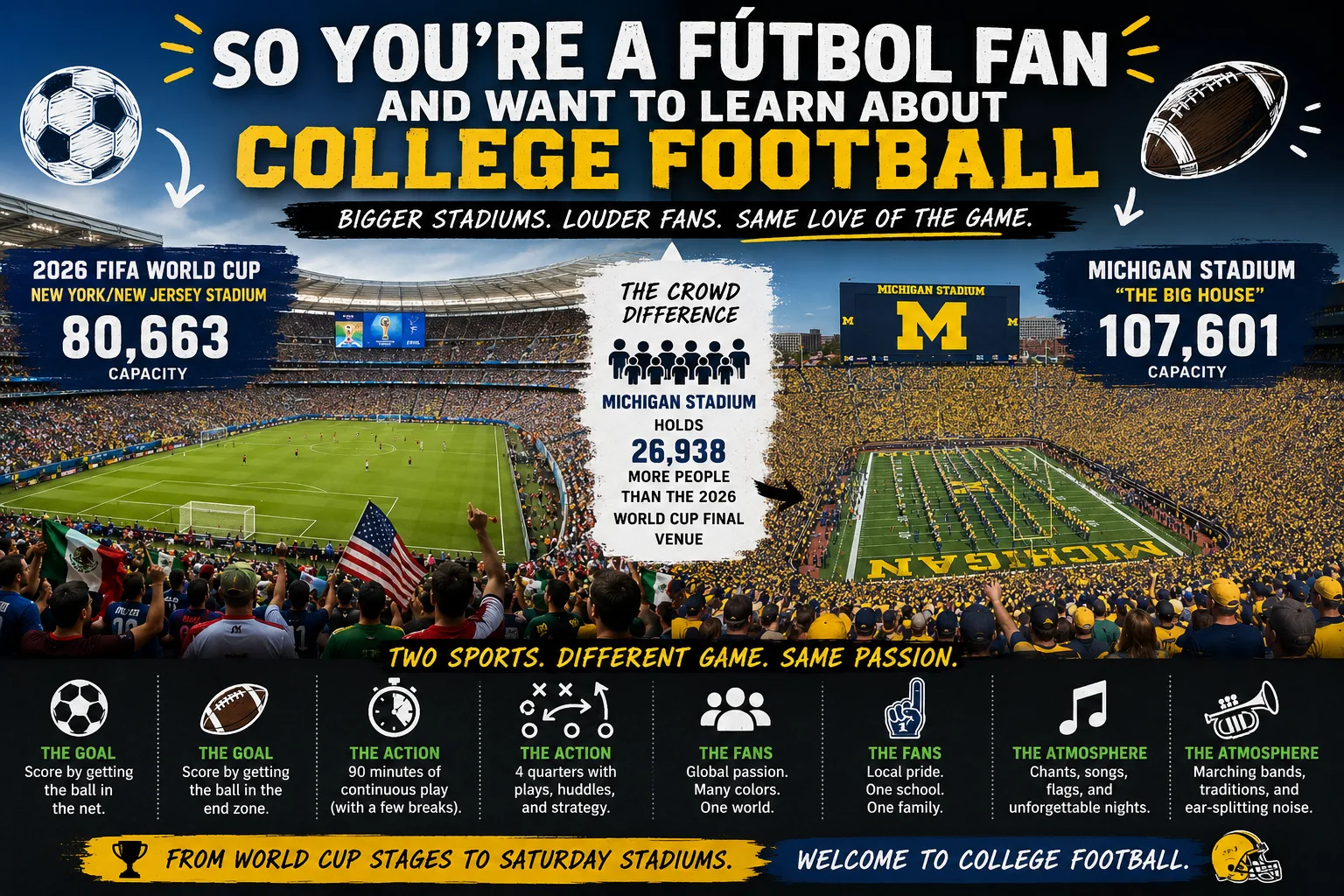
Welcome, fútbol fan. You have watched a winger cut inside, you have screamed "OFFSIDE!" at a television with the confidence of a Supreme Court justice, and you understand that a 0-0 draw can be beautiful, tactical, and somehow also feel like being trapped in an elevator with a philosophy professor.
Now you are World Cup-ready. North America is hosting the biggest fútbol party on Earth, and suddenly you keep hearing Americans say things like, "Wait until you see a Saturday night in Death Valley," which sounds less like a sport and more like an invitation to be eaten by a dinosaur.
So what is college football? Why are the stadiums the size of small nations? Why do fans spend 11 hours grilling meat before a game that contains about 13 minutes of actual ball movement? And why is everyone so emotionally invested in a 19-year-old quarterback who may or may not be taking Intro to Communications?
Let's begin.
The 2026 FIFA World Cup is the perfect gateway drug. This edition is the first 48-team World Cup, with 104 matches across Canada, Mexico, and the United States, running from June 11 to July 19, 2026. The opening match was set for Mexico City Stadium, and the final is scheduled for New York New Jersey Stadium. In other words: fútbol has come to North America, and North America has responded by saying, "Great, but have you considered marching bands?"
Here is the first thing to understand: college football is not simply "American football, but younger." That is like saying the World Cup is "a soccer tournament, but with flags." Technically correct, emotionally ridiculous. College football is sport, geography, tribal identity, family tradition, traffic jam, weather event, drumline rehearsal, and group therapy session all wearing shoulder pads.
A fútbol fan understands club loyalty. College football is that, but the club is also a school, a town, a marching band, a fight song, a barbecue style, a hand gesture, and possibly your grandfather's entire personality. You do not merely "support" Alabama, Michigan, Ohio State, Texas, LSU, Notre Dame, Georgia, or Tennessee. You inherit them, like eye color or a suspiciously strong opinion about sauce.
Now, the game itself.
In fútbol, the goal is elegant: put the ball in the net. In college football, the goal is to move an egg-shaped ball into a painted rectangle called the end zone while 11 defenders attempt to fold you into a lawn chair. A touchdown is worth six points. After that, you may kick for one extra point or attempt a two-point conversion, because apparently scoring once was not enough paperwork. A field goal is worth three. A safety is worth two and mostly exists so announcers can say, "You don't see that every day," even though they absolutely live for it.
The most important concept is downs. Imagine fútbol, but instead of flowing continuously, the referee stops everything every few seconds and asks, "Right, what was your plan, gentlemen?" The offense gets four chances, called downs, to move the ball 10 yards. If they succeed, they get a fresh set of four downs. If they fail, they usually punt, which is the American football version of clearing the ball long except everyone pretends it is a chess move.
For a fútbol fan, the easiest comparison is this: every football play is a set piece. Every snap is a free kick, corner, or restart with a 300-page tactical manual attached. The quarterback is part playmaker, part goalkeeper, part exhausted air-traffic controller. The offensive line is the wall on a free kick, except the wall is allowed to wrestle. The wide receiver is the speedy winger. The running back is the striker who says, "What if I dribbled directly through five defenders and simply accepted the medical consequences?"
And the coach? The coach is not standing there in a quarter-zip because he is cold. He is engaged in a spreadsheet knife fight. If you want proof, spend five minutes inside the college football coaches hub and then try to explain why every fan base thinks the offensive coordinator is ruining Thanksgiving.
Now let's talk about atmosphere, because this is where college football starts sounding less like a sport and more like a regional fever dream.
A World Cup match is a spectacular global carnival: national anthems, flags, drums, scarves, painted faces, entire countries losing their minds at once. College football says, "Cute. We do that every Saturday, but also at 9 a.m. in a parking lot."
This is called tailgating. Tailgating is when fans arrive hours before kickoff to eat, drink, argue, play cornhole, set up tents, watch other games, and behave as if the actual football game is merely the halftime show for the brisket. To a fútbol fan, tailgating may look like a fan zone outside a World Cup stadium. But imagine the fan zone was run by your uncle, powered by generators, and emotionally dependent on a cooler full of ribs.
Then there are the stadiums.
Here is where your brain may need a seat belt. The 2026 World Cup venues are massive. FIFA finalized capacities including Mexico City Stadium at 80,824, New York New Jersey Stadium at 80,663, Dallas Stadium at 70,649, Los Angeles Stadium at 70,492, and Toronto Stadium at 43,036. Those are enormous crowds. That is enough people to make any normal human whisper, "Maybe I'll watch from home."
But college football looked at 80,000 people and said, "Adorable starter home."
Michigan Stadium, nicknamed "The Big House," has a listed capacity of 107,601 and is widely recognized as the largest stadium in the United States. CFBTrack's largest college football stadiums by capacity list puts Beaver Stadium at Penn State at 106,572, Ohio Stadium at 102,780, Kyle Field at Texas A&M at 102,733, Tiger Stadium at LSU at 102,321, and Neyland Stadium at Tennessee at 101,915.
Let's put that in fútbol terms. The 2026 World Cup final venue in New York/New Jersey is listed at 80,663. Michigan Stadium seats about 26,938 more people than that. That is not "a few extra rows." That is like taking the World Cup final, then adding an entire medium-sized stadium full of people who all own a maize hoodie and are yelling at a third-and-short play call.
Michigan Stadium is also about two and a half times the size of Toronto Stadium's World Cup capacity of 43,036. Imagine watching a World Cup match in Toronto, loving the atmosphere, then being told, "Great, now clone this crowd, double it, add another half, give everyone a fight song, and make them mad about a rivalry from 1912."
That is college football.
And it is not only Michigan. Penn State's Beaver Stadium is basically a city with bleachers. Ohio Stadium, called "The Horseshoe," sounds like something a medieval army would defend. LSU's Tiger Stadium is also known as Death Valley, because apparently "Large Outdoor Seating Structure" did not test well with focus groups. Texas A&M's Kyle Field is home of the "12th Man," a phrase that fútbol fans will enjoy because it also sounds like crowd power, except here it includes coordinated yelling, military tradition, and the possibility of a yell leader wearing overalls.
This is the biggest adjustment for fútbol fans: college football crowds are not just watching. They are participating in a group ritual. Some stadiums are famous for noise. Some for songs. Some for traditions that require a 40-minute explanation and a family tree. Some for looking like every person in the state has decided to wear the same color on the same day, creating a visual effect best described as "national emergency, but festive."
Penn State has the White Out. Tennessee has a sea of orange. LSU plays at night and becomes a place where logic goes to nap. Wisconsin has "Jump Around." Virginia Tech enters to "Enter Sandman." Iowa waves to a children's hospital. Texas A&M has Midnight Yell. Florida has The Swamp. Colorado has a live buffalo, because sometimes the mascot department just says yes.
If fútbol has tifos, college football has marching bands. And listen, marching bands are not background music. They are tactical artillery. They storm the field in formation. They spell words. They play fight songs until your soul accepts them. In fútbol, a chant may evolve organically from the terraces. In college football, a sousaphone will inform you that tradition has already been scheduled.
Another key difference: the season is short and panic begins immediately.
In European fútbol, a club can lose in September and still recover. In college football, one bad Saturday can cause a fan base to enter a full constitutional crisis. There are only about 12 regular-season games. Every week matters. Every upset is treated like a small meteor strike. If your team loses to a rival, people will discuss it at weddings.
This is where the World Cup comparison really helps. College football feels less like a long league season and more like a series of mini World Cup knockout matches, except the tournament lasts all fall and half the teams are named after animals, weather, or historical professions. A September road game at night can feel like an away match in a hostile World Cup stadium, but instead of national flags, everyone is waving foam fingers and asking whether the defensive coordinator should be fired.
The rivalries are very fútbol-coded. Think Argentina vs. Brazil, England vs. Germany, Mexico vs. USA, then localize that energy into one state, one border, one trophy, or one argument that began before television. Michigan vs. Ohio State is simply called "The Game," which is arrogant until you see the emotional damage it causes. Alabama vs. Auburn is the Iron Bowl, a rivalry so intense it makes family gatherings feel like diplomatic summits. Army vs. Navy is tradition in uniform. Oklahoma vs. Texas is the Red River Rivalry, played at the State Fair because nothing says "elite athletic competition" like fried food and generational resentment.
You may also be wondering: "Why are these giant college stadiums not hosting more World Cup matches?" The short answer is that World Cup hosting is not just about capacity. FIFA needs specific venue operations, city infrastructure, training sites, hotels, airports, media facilities, field dimensions, hospitality, and transportation. A 107,000-seat stadium in a college town may be majestic, but it may not be the easiest place to move global fan bases, sponsors, teams, press, and security across an entire tournament. The World Cup is a city event. College football is often a campus invasion.
That distinction is part of the charm. World Cup venues are built for the world to arrive. College football stadiums are built for everyone who already believes they belong there.
To enjoy college football as a fútbol fan, pick a team the way you might pick a club. Do you like giants with impossible expectations? Try Alabama, Georgia, Ohio State, Michigan, Texas, or Notre Dame. Do you enjoy chaos, purple, and night games that feel like a haunted festival? LSU is waiting. Do you like pain with excellent uniforms? There are many options; college football is a buffet of heartbreak. Do you want a beautiful stadium, a weird tradition, and an annual chance to ruin someone else's season? Congratulations, you understand the sport.
You should also embrace the pageantry. Do not fight it. When someone explains that a live eagle flies before Auburn games, nod respectfully. When someone says their team touches a rock before running down a hill, accept that the rock is important. When someone tells you a rivalry trophy is a wooden pig, a golden hat, an axe, or a jug, do not ask too many questions. Every sport has its sacred objects. Fútbol has the World Cup trophy. College football has many trophies, and several look like they were found in a grandfather's garage.
Most importantly, do not make the rookie mistake of comparing the sports as if one must defeat the other. Fútbol is fluid, global, poetic, cruel. College football is explosive, regional, theatrical, cruel. Fútbol gives you 90 minutes of tension that may be decided by one touch. College football gives you four hours of tension that may be decided by a backup kicker named Brayden who has an economics midterm on Tuesday.
Both sports understand the same basic truth: people love belonging to something loud.
So as the World Cup turns North America into a summer-long fútbol carnival, let it also be your invitation into college football. Notice the stadiums. Notice the scale. Notice that the same country hosting World Cup matches in 70,000- and 80,000-seat venues also has college towns casually packing more than 100,000 people into games played by students.
That is the magic. That is the absurdity. That is the point.
The World Cup is the planet's greatest fútbol festival. College football is America's weekly reminder that a university can become a religion, a parking lot can become a kitchen, and 107,601 people can gather in one place to scream because a teenager threw an oblong ball six inches too high.
Welcome to college football.
Bring sunscreen, learn the fight song, and never schedule brunch on a Saturday.