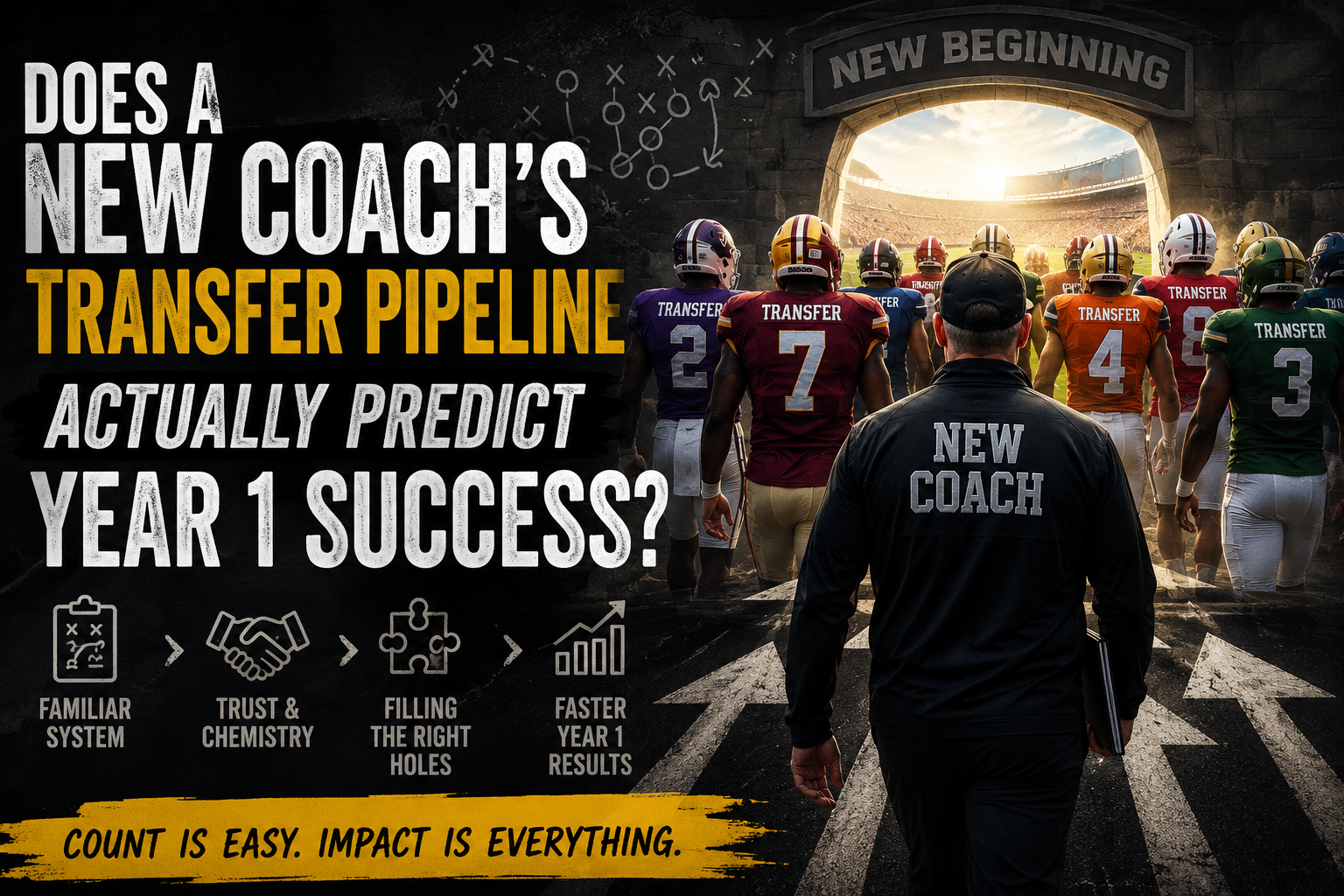
Does a New Coach’s Transfer Pipeline Predict Year 1 Success?
New coaches often bring familiar players through the portal, but CFBTrack data shows volume alone is a weak Year 1 signal. The real edge comes when those transfers fill high-leverage roster holes.
On this page
When a college football program hires a new head coach, the first fan question is almost always the same: who’s coming with him?
The transfer portal has changed what a Year 1 rebuild can look like. A coach no longer has to wait three recruiting cycles to install a culture, find scheme fits, and develop a young roster. He can import players who already know the practice standard, the terminology, the defensive checks, the offseason expectations, and the personality of the staff.
That creates an obvious theory: if a new coach brings a lot of players from his former team, his first-year roster should improve faster.
More Isn’t Always Better#
Using CFBTrack transfer portal and game-result data from the five completed modern-transfer seasons from 2021 through 2025, the answer is not a clean yes.
A former-team transfer pipeline can speed up a rebuild, but only when those players are good enough, healthy enough, and placed into the right roster holes.
The numbers do not tell the whole story. Impact does.
The Best Proof Case Is Indiana#
The strongest argument for the transfer-pipeline theory is 2024 Indiana.
Curt Cignetti arrived from James Madison and did not treat Indiana like a slow rebuild. CFBTrack counted 13 James Madison-to-Indiana transfers in 2024. Public transfer trackers put Indiana’s overall intake at roughly 30 transfers, with multiple summaries also identifying 13 former JMU players in the group.
The result was one of the most dramatic first-year turnarounds in recent college football. Indiana went from 3-9 in 2023 to 11-2 in 2024. That was not just better than expected. That was a program changing its entire weekly ceiling.
The important detail is that the JMU transfers were not decorative depth. Elijah Sarratt became a major receiving piece. Aiden Fisher and Jailin Walker gave the defense familiar second-level leadership. D’Angelo Ponds, Mikail Kamara, James Carpenter, Kaelon Black, Ty Son Lawton, and others gave Indiana players who already understood how Cignetti wanted to operate.
That is the transfer-pipeline thesis at its purest. A new coach brought trusted players into real roles, and those players helped change the team’s weekly identity immediately.
But even Indiana is not only a headcount story. It is a role-fit story. The pipeline mattered because the players were useful, not simply because there were a lot of them.
USC Shows Why Count Can Mislead#
Lincoln Riley’s 2022 USC debut is the counterexample that proves the same point from the other direction.
CFBTrack counts three Oklahoma-to-USC transfers on Riley’s first Trojan roster: Caleb Williams, Mario Williams, and Latrell McCutchin. That is not a huge former-team pipeline, but it included the most important position in the sport.
USC went from 4-8 in 2021 to 11-3 in 2022. Riley did use the portal heavily overall, but the Oklahoma-to-USC pipeline was about quality more than quantity. Caleb Williams gave Riley a quarterback who already knew the system and could execute it at a Heisman level. Mario Williams added another familiar offensive weapon.
If the question is “does bringing a lot of former players predict Year 1 success?” USC complicates the answer.
Riley did not need ten Oklahoma players.
He needed the right Oklahoma player.
The Southern Miss 2025 Case Pushes the Theory Further#
Charles Huff’s move from Marshall to Southern Miss in 2025 is the most extreme recent example in the data.
CFBTrack counted 19 Marshall-to-Southern Miss transfers. Southern Miss game notes later listed 21 former Marshall players and 10 coaches who followed Huff from Huntington to Hattiesburg. That is not just a pipeline. That is close to a portable ecosystem.
The Year 1 result was meaningful. Southern Miss went 1-11 in 2024, then reached bowl eligibility in 2025 and finished 7-6 after the bowl. The imported Marshall group included quarterback Braylon Braxton, defensive back Josh Moten, wide receiver Elijah Metcalf, receiver Carl Chester, and a long list of players who gave Southern Miss immediate structure after a rough stretch.
This case supports the theory, but with context. Southern Miss was starting from a very low baseline. A competent roster injection could create a large win jump because the previous season left so much room for improvement.
The Marshall group mattered. So did the fact that Southern Miss had urgent needs almost everywhere.
The Warning Labels: Washington, Arizona, and Colorado State#
The clearest reason not to treat former-team transfer count as a prediction model is that several large or meaningful pipelines did not create immediate Year 1 success.
Jedd Fisch brought a large Arizona group to Washington in 2024. CFBTrack counted 10 Arizona-to-Washington transfers, including players such as Jonah Coleman, Ephesians Prysock, Demond Williams Jr., Audric Harris, and Isaiah Ward.
Washington still went 6-7 after going 14-1 and playing for the national title the year before.
That does not mean the Arizona transfers failed. It means the job was bigger than the pipeline. Washington had just lost a national-title-game core, NFL-level talent, and coaching continuity. Familiar players helped rebuild the roster, but they could not replace that much production overnight.
Brent Brennan’s 2024 Arizona season is another cautionary example. Arizona added several San Jose State transfers after hiring Brennan, but the Wildcats fell from 10-3 in 2023 to 4-8 in 2024. The issue was not simply whether Brennan had familiar players. Arizona was absorbing a coaching change, roster losses, and a move into the Big 12.
Jay Norvell’s 2022 Colorado State debut is another warning. Colorado State added a group of Nevada transfers that included Clay Millen, Avery Morrow, Tory Horton, Jacob Gardner, and others. The Rams still went 3-9 in Norvell’s first season.
The lesson is simple: familiarity can reduce friction, but it cannot erase roster holes, schedule difficulty, injuries, or bad line play.
Colorado Is the Strange Middle Case#
Deion Sanders at Colorado in 2023 is one of the most famous portal rebuilds ever, but it is not a clean example of the former-team pipeline.
Public transfer lists show a notable Jackson State-to-Colorado group, headlined by Shedeur Sanders, Travis Hunter, Shilo Sanders, Cam’Ron Silmon-Craig, Alejandro Mata, Willie Gaines, and others. CFBTrack’s structured FBS portal data undercounts this because Jackson State is an FCS origin and some records carry null origin-team values.
Colorado improved from 1-11 in 2022 to 4-8 in 2023. That was real progress, and the former Jackson State stars mattered. Shedeur Sanders and Travis Hunter gave Colorado instant relevance and high-end talent.
But Colorado’s bigger story was total roster churn. The Buffaloes added transfers from everywhere, not just Jackson State. That makes the season useful for understanding how a familiar-player pipeline can shape a rebuild, but risky as a simple model.
Colorado shows that an old-player pipeline can create identity and star power while still leaving the overall team short of a winning season.
What the Buckets Say#
A simple bucket test makes the point.
Among a selected set of FBS head-coach moves from 2021 through 2025, coaches who brought five or more former-team transfers did not clearly outperform everyone else in Year 1.
The high-count group included clear success stories like Cignetti at Indiana and Huff at Southern Miss. It also included warning-label seasons like Fisch at Washington, Brennan at Arizona, and Norvell at Colorado State.
The lower-count group had some of the strongest Year 1 jumps in the sample. USC is the cleanest example: Riley did not bring a massive Oklahoma group, but the group included Caleb Williams.
That does not mean bringing former players is bad. It means the relationship is not linear. Five familiar players are not automatically better than two. Ten are not automatically better than three.
The portal is not a loyalty punch card.
The Real Predictor Is Role Fit#
The better question is not how many former players followed a coach. It is what jobs those players took.
A former quarterback who already knows the offense can matter more than five depth defenders. A center or linebacker who can set calls can stabilize a team faster than a stack of rotational players. A receiver who understands route conversions can make a new quarterback more comfortable.
That is why Indiana worked. The JMU transfers were not just familiar; they became part of the engine.
It is why USC worked with only a few Oklahoma transfers. Caleb Williams was worth more than a large but ordinary group.
It is why Southern Miss improved. Huff imported a quarterback, defensive backs, receivers, and staff continuity into a program that badly needed structure.
The misses make the same point. Washington brought real players from Arizona, but the inherited roster situation was too depleted compared with the previous standard. Arizona brought familiar San Jose State players, but the program was absorbing bigger losses. Colorado State brought Nevada players, but Year 1 still exposed deeper issues.
The Blog Takeaway#
A new coach’s transfer pipeline is a useful signal, but it is not a standalone predictor.
It tells us the coach has player trust. It tells us some players believe the system travels. It can give the locker room early translators who understand the staff before everyone else does.
But it does not tell us whether the offensive line is good enough, whether the quarterback is a difference-maker, whether the schedule is manageable, whether the previous roster was hollowed out, or whether the imported players are actually better than the players they replace.
The best way to frame it is this: former-team transfers are accelerants, not foundations.
They can make a good rebuild catch fire quickly. They cannot make a bad roster complete by themselves.
So does a new coach’s transfer pipeline predict Year 1 success?
Not by volume.
But when it delivers trusted, high-impact players into the exact holes a roster needs filled, it’s one of the fastest ways a first year can outrun expectations.
Source notes used: CFBTrack transfer portal and game-result data; Indiana/JMU transfer reporting; USC’s 2022 signing release; Southern Miss 2025 game notes; public transfer and season-record references for Washington, Arizona, Colorado State, and Colorado.